What the Claude Fable ban means for firms adopting AI
Overview
As of Jun 12 2026, the US government issued an export directive to Anthropic to limit access to Claude Fable 5 and Mythos 5 to native US-born citizens only, even excluding access to foreign US citizens who actually contributed to building out the model!
This has come about as a result of an insider report to the US government that the model was able to be “jailbreaked”.
Anthropic have claimed that this so called jailbreak method can be applied to other frontier models that haven't faced such scrutiny, including OpenAI’s GPT-5.5
If this standard was applied across the industry, we believe it would essentially halt all new model deployments for all frontier model providers.
As a result of this news, the public has gone into a mass hysteria. Many claim that this is the start of the permanent underclass, where a set of elites – or people with specific privileges – access certain technologies that are able to differentiate the quality of work they produce so greatly compared to those that don’t have access.
There is now a cry for building out “Sovereign AI”. Deploying open source models within your own computing infrastructure, perhaps backed by a GPU server or even your own local machine, that you can use freely whenever you like (and however you like), in order to leverage the intelligence and productivity gain of AI.
But sovereign AI is not a new concept. Open source models started gaining traction post-ChatGPT fairly quickly, but never quite caught on mainstream. The reason is that most folk who cared about privacy were very tech oriented and deep in the weeds of AI that normal folk didn’t pay attention to.
The Problem
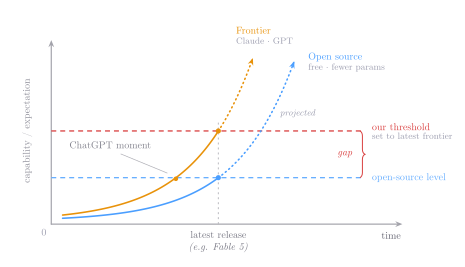
The problem with base open source models is not that they are complicated to set up or that they cost much to host and infer.
It’s that they're simply not good enough.
Not good enough compared to what we’ve seen be possible.
And because of this simple fact – and by human nature – we can not settle with the open source models until they reach a point that meets our happy threshold.
But why are they not good enough?
Simply because they haven’t got enough parameters, and when we pay subscriptions to use Claude or ChatGPT, we are essentially renting some compute that is required to power these resource intensive, but extremely useful large language models.
Given open source models are free and are typically used solo, or to build out your own models, they simply aren’t trained on enough data to meet the performance of the frontier models.
So now there becomes a huge disparity between the current stage we are at in the race to Artificial Super intelligence where the best models – that really elevate the builders/researchers of today – are blocked and governed by big brother, all while the rest of us are left with a sub par version of open source intelligence to ‘play around with’.
The Catch
However, no matter how poor the performance, with open source models you control it. You control its lifecycle. You control what gets fed into it. You control its future behaviour, and most importantly you control how it is being used.
This level of governance over AI use becomes extremely important for enterprise companies that might begin to rely on these large language models to deliver professional services, but would have been behest of the AI labs in San Francisco.
It’s a slippery slope, and the problem is that it doesn’t feel like anything can go wrong, but once it does, it truly hits you in your face.
So although, the open source models are not as good. They are honestly good enough for what you want to do… given that you are a trusted craftsman of giving instructions. So realistically, it comes down to how good you are at giving an instruction and the necessary information to complete that instruction.
The Solution
So we've established that the open source models are good enough – if you're a trusted craftsman of giving instructions. But there's a second half to that sentence that matters just as much. It's not just about how you instruct. It's about what the model actually knows at the moment you instruct it. Here's the thing nobody tells you: the answer you're looking for is almost always already in there. These models have read more than any human could in a thousand lifetimes. The intelligence is present. The capability is present.
The problem is that it's a needle in a haystack.
The model most likely has exactly what you need buried somewhere in all that intelligence – the issue is getting it to surface that one thing and not the ten thousand other things it also knows. You have to direct it. You have to filter out the noise. You have to walk it to the needle.
And the way you do that is context.
Not generic context. YOUR context. Your documents. Your way of doing things. Your intent. Because the core problem – the one sitting underneath every disappointing output you've ever gotten – is that the model doesn't understand your intent. It doesn't know your business. It doesn't know the unwritten rule that everyone on your team just knows but nobody ever wrote down. It's answering into a vacuum, and a vacuum produces generic slop.
So you fill the vacuum.
There are two ways to do this, and you want both.
- build a RAG system.
Retrieval Augmented Generation – fancy name, simple idea. You take all the stuff that lives in your company's head and you make it available to the model exactly when it's relevant. Your custom documentation. Your staff handbook. The implicit notes nobody bothered to formalise. The email threads where the real decisions actually got made. All of it. You don't dump it in all at once – that just builds a bigger haystack. You feed it in when it matters, for the task in front of you. The model stops guessing and starts working from your actual reality.
- give it tools.
Context isn't only the stuff you have lying around – a huge amount of it lives in the systems you use every single day. So you wire the model into those systems and let it go and fetch context when it needs it. Google Drive connectors. Access to the databases that actually hold your information. Hooks into the workflows you already run.
Now the model isn't just working from a snapshot you handed it. It can reach out, pull what it needs, and ground itself in the live state of your business.
And here's the kicker – you can do all of this on an open source model. On your own infrastructure. Under your own governance. The thing big brother just locked behind a citizenship test? You can get most of the way there yourself, in your own house, with the door locked from the inside.
Conclusion
So where does that leave us? The Fable ban might end up being the moment everyone looks back on as the day AI stopped being a level playing field. Maybe it really is the start of the permanent underclass. Maybe the elites get the good stuff and the rest of us get the scraps.
Or maybe not.
Because the gap between the frontier models and the open source ones was never really about raw intelligence It was about context. The labs in San Francisco didn't just hand you a smarter model – they handed you a model that felt like it understood you, because of all the scaffolding wrapped around it.
And scaffolding, you can build yourself.
You don't need permission. You don't need a passport. You don't need to be on a list in San Francisco. You need your documents, your tools, your systems, and enough discipline to direct the thing properly.
Sovereign AI was never about having the biggest model. It's about owning the whole stack – the model, the context, the lifecycle, and the intent behind every instruction.
The craftsman with the right tools and his own materials will always beat the amateur renting someone else's workshop.
So build your workshop.